
Running a Sex Offender Check in Bay County
The Michigan State Police Public Sex Offender Registry, commonly called PSOR, is the direct official search. It is a public subset of a larger law-enforcement registry that also contains nonpublic information. A county filter can isolate published Bay County profiles. A neighborhood map is better when the question concerns a specific address, and a name or registration-number query is better when the person is already known.
The Michigan Public Sex Offender Registry search is the primary Bay County source.
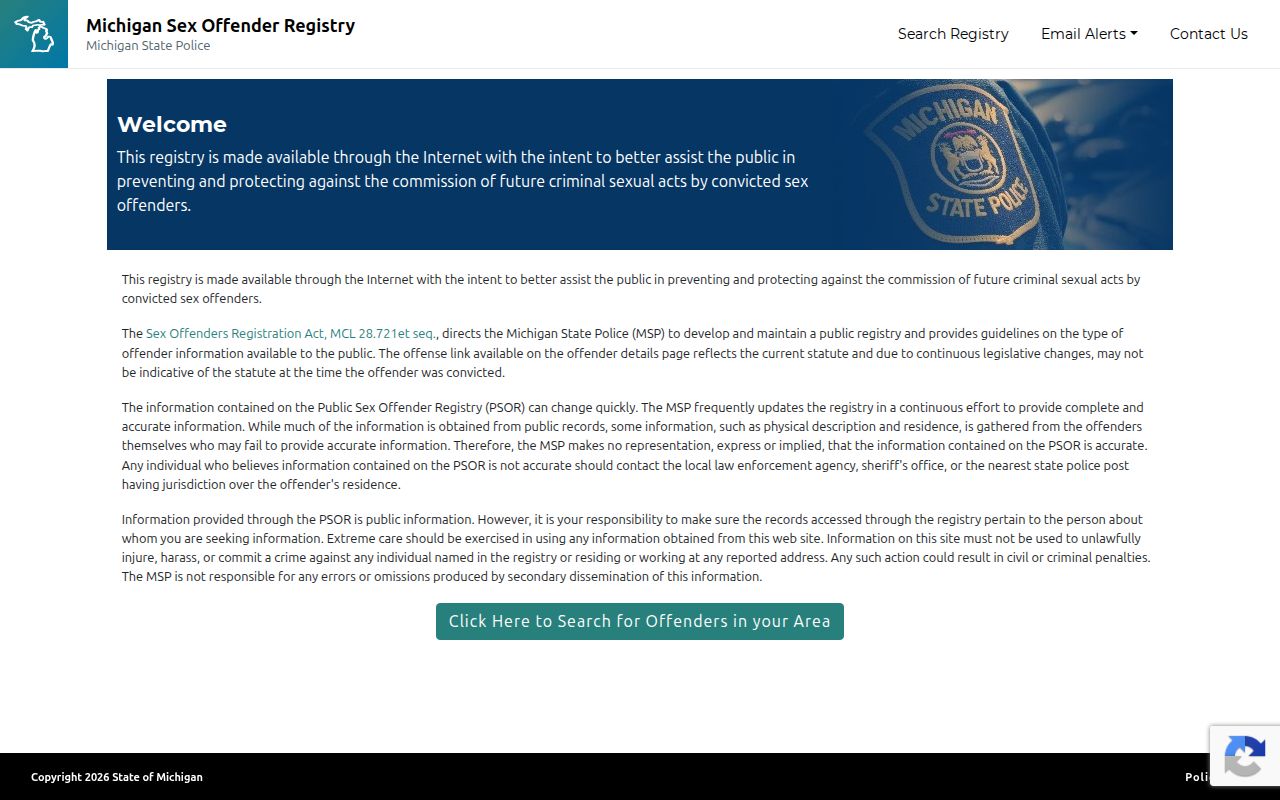
The result should be treated as a current public registry entry, not a full criminal-history report. Use the court file to understand the conviction and ICHAT for public statewide criminal history. Call Bay County Sheriff Records at (989) 895-4050 for local registration routing.
Bay County Registry Radius Choices
The neighborhood map accepts a street, city, ZIP code, and county, then offers radii of 0.25, 0.50, 1, 2, or 5 miles. A smaller ring can answer an immediate block-level question, while the wider setting gives broader Bay County context. Select a result photo or “View Details” to open the profile. “Map Offender” opens an adjustable map when the registered address has been mapped.
A grey map control means the address has not been mapped. It does not mean the person supplied no address and does not erase the profile. PSOR also provides preset lists for all published, all incarcerated, and all non-compliant registrants. Those lists describe registry status, not a complete list of people with any sex-offense conviction.
Note: Print an individual profile when a dated reference is needed; Michigan does not offer a download of the full registry.
Searching the Michigan Public Sex Offender Registry
Choose a search mode that matches the known facts. Partial first and last names are accepted together. A registration or MDOC number offers a tighter match. Geographic searches work by county, city, ZIP code, or a street-based neighborhood map.
- Open PSOR and review the conditions of use before searching.
- Enter a first and last name, an identifier, or a Bay County geographic filter.
- Compare the result list by name, photograph, date of birth, and other displayed identifiers.
- Select “View Details” and read status, address, listed offense, registration details, and map information together.
| Field or mode | Type | Required | Use |
|---|---|---|---|
| First and last name | Text | Paired | Partial names accepted |
| Registration/MDOC number | Text | No | Direct identifier search |
| City, county, or ZIP | Text/select | No | Choose Bay for county results |
| Street address | Text | Conditional | Combine with city, county, or ZIP |
| Neighborhood map | Map fields | No | Search 0.25 to 5 miles from an address |
| Preset lists | Links | No | Published, incarcerated, or non-compliant |
Use more than a name when possible. A photograph, birth date, registration number, and location can prevent a mistaken match. If the map and text fields appear inconsistent, rely on the profile details and contact MSP about an apparent error rather than drawing a conclusion from map placement alone.
Bay County Offender Email Alerts
PSOR can monitor a place or one published profile. For a location alert, select Email Alerts and Register, choose a radius, and enter a physical address and email address. Both are required. Accept the terms and submit. MSP says a confirmation should arrive within 24 hours. Location notices can cover a published registrant moving into the radius, enrolling in school, or becoming employed there.
One email can monitor several physical addresses, but each address needs its own registration. To follow one profile, open View Details, choose Track Offender, enter the email twice, accept the terms, and register. Unregistering an email removes every tracked-person and location notice tied to it. Alerts are an aid, not a substitute for other safety steps or direct law-enforcement help in an emergency.
What a Registry Profile Shows
Michigan public profiles combine identification, location, status, and a short conviction summary. The public-information line is controlled by MCL 28.728. The underlying registry includes more data than PSOR may publish, so the profile should never be described as a complete government file.
| Name and aliases | Primary name plus published alternate identities and registration number. |
|---|---|
| Photo and description | Current photo, physical traits, and published scars, marks, or tattoos. |
| Address and activity | Residential and map data plus published campus, vehicle, plate, and neutral work field. |
| Offense | Brief listed-offense conviction summary and linked or quoted law text. |
| Tier | Administrative tier is not public and should not be guessed from the offense label. |
| Status | Registration and compliance labels such as Active, Incarcerated, Absconder, or a named violation. |
Victim identity, Social Security number, non-conviction arrests, immigration and travel-document numbers, tier classification, and driver-license or state-ID data are excluded from public display. Review Bay County arrest history separately when the issue is a custody event rather than registration.
Reading Bay County Registry Status
Status terms should be repeated exactly. Active, Incarcerated, Pending Out of State, Inactive Out of State, Absconder, Homeless, School Only, and Employment Only describe different registration circumstances. “Absconder” means whereabouts are unknown after departure from the last reported address. It does not authorize a search, confrontation, or public accusation.
Non-compliant is also not one single act. Michigan uses labels for Address, Campus, Employment, Failed to Register, Failed to Verify, False Information, Fee, Form, ID, Immigrant Documents, Professional License, Telephone, and Vehicle Violation. Cite the label that appears rather than turning it into a broader claim. Apparent violations should go to the law-enforcement agency serving the actual address. Profile errors can be reported through the profile’s Submit a Tip feature.
Note: A registry compliance label is not proof that the person committed a new criminal offense.
Registration Requirements and Levels in Michigan
The Michigan Sex Offenders Registration Act creates three administrative tiers. They are statutory categories, not individualized danger scores. The underlying offense, victim age, prior convictions, and statutory exceptions can affect classification. Registration time does not run during incarceration.
| Administrative tier | Duration | Verification | Public visibility |
|---|---|---|---|
| Tier I | 15 years | Annual | Tier itself is excluded from PSOR display |
| Tier II | 25 years | Twice yearly | Tier itself is excluded from PSOR display |
| Tier III | Life | Quarterly | Tier itself is excluded from PSOR display |
Registrants generally report in person within three business days after a residence, work, legal-name, or higher-education change. Certain temporary lodging, vehicle, and phone changes may be mailed, dropped off, or reported in person within that period. Out-of-state moves are reported no more than three business days before moving; an international move requires 21 days. Michigan lists a $50 initial fee and a $50 annual fee, subject to an aggregate $550 maximum and indigency provisions. Those administrative duties belong to the registration system and do not reveal a hidden public tier.
Missing Bay County Registry Results
Public visibility is not as simple as “all tiers.” A profile may be absent because of a juvenile adjudication, death, nonresidence, an offense outside the published list, timing before October 1995, judicial removal, a set-aside, Holmes Youthful Trainee Act treatment, an ended registration period, or a specified single-offense exclusion. The public tier is not shown, so do not reverse-engineer a tier and present it as a profile fact.
The Michigan State Police registry information source explains the public system and its limits.
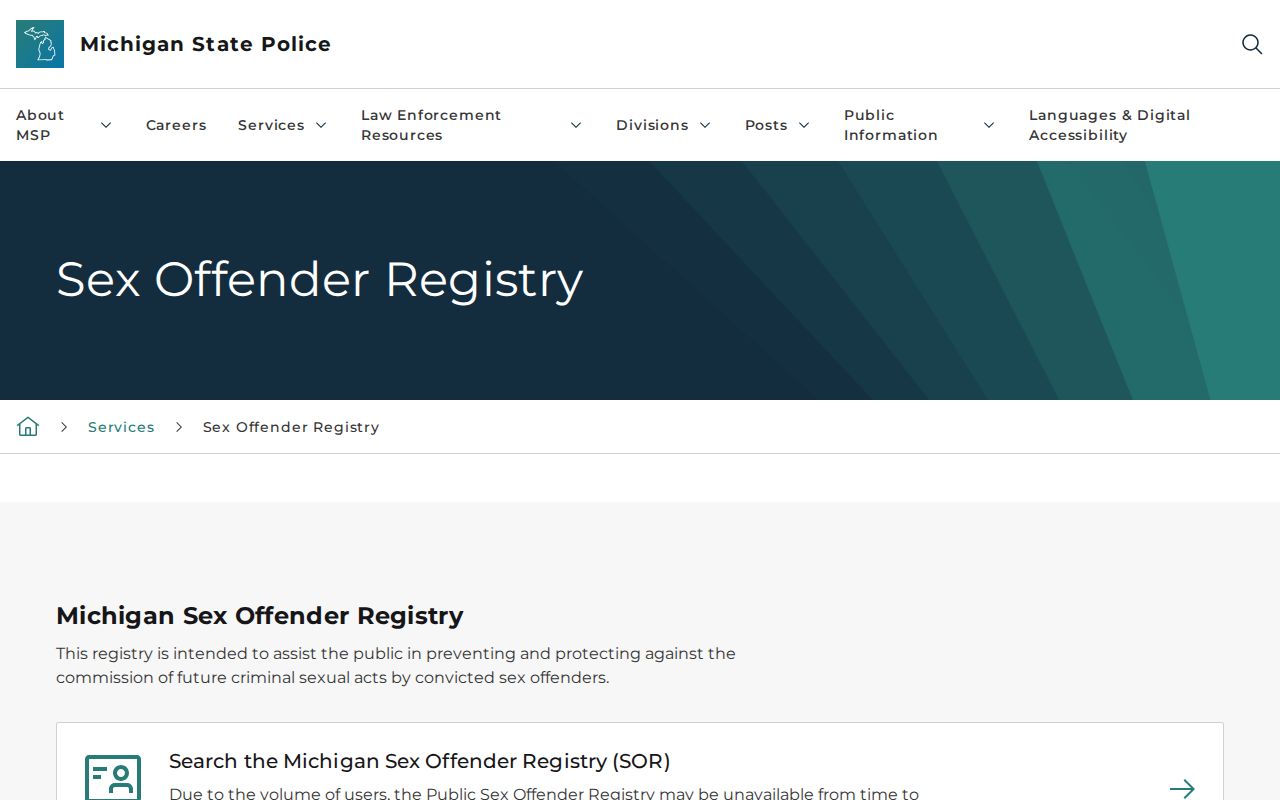
If PSOR is unavailable, retry later as MSP directs, then use the national search and call the MSP Sex Offender Registry unit at (517) 241-1806. A missing PSOR result is not proof of no conviction. MiCOURT, ICHAT, and the official court file answer different questions.
Bay County and the National Registry
The U.S. Department of Justice’s National Sex Offender Public Website searches participating jurisdictions across state lines. It is useful when a person may have moved or when a neighborhood question crosses Michigan’s border. NSOPW inherits each jurisdiction’s matching rules, publication limits, and update process. It does not convert every state registry into one uniform national file.
The National Sex Offender Public Website provides that cross-state layer.
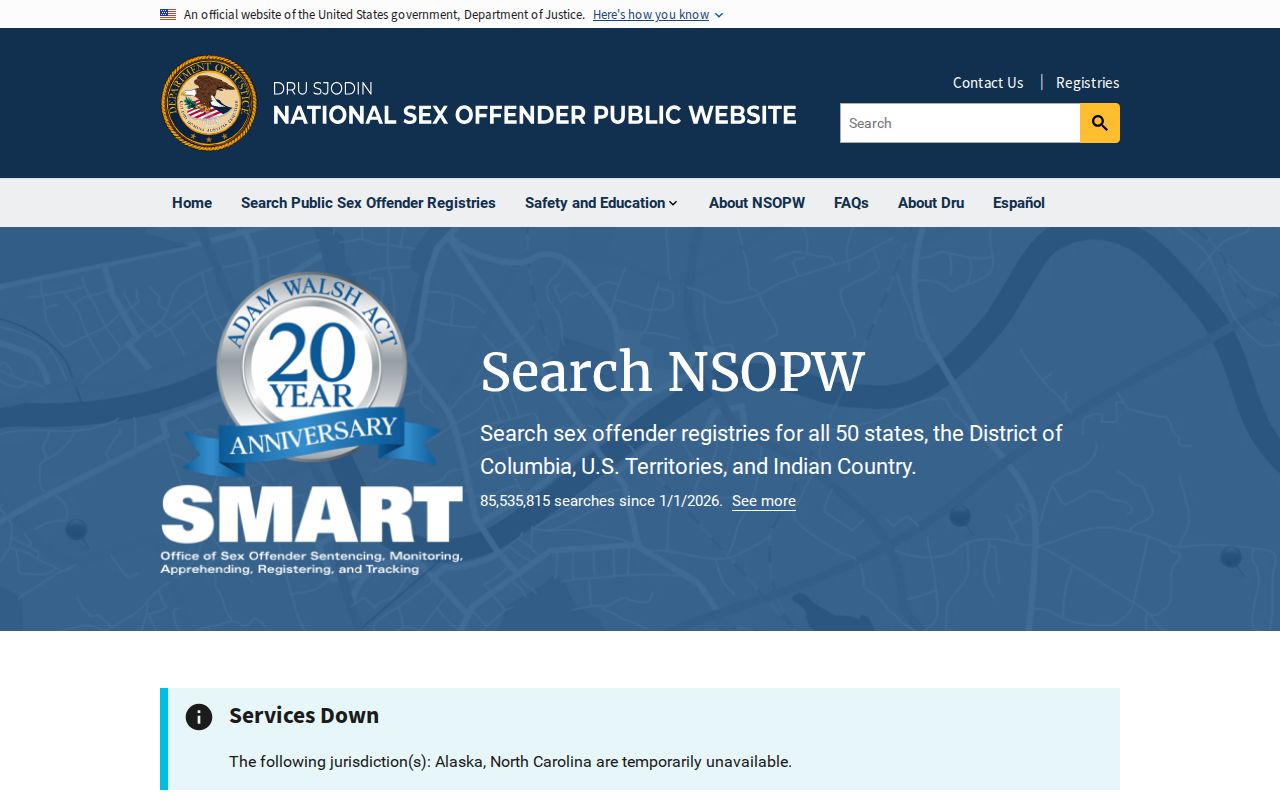
For a Bay County address, confirm a national match against the Michigan profile. Names and locations may have changed, and an out-of-state record follows the publishing state’s law. For an offense or disposition question, consult the originating court rather than inferring the case outcome from a short registry summary.
Lawful Use and Community Notification
Registry records support community awareness and personal or family safety planning. They do not declare that a listed person has committed new wrongdoing. Michigan’s former statewide school-zone residency regime was repealed in 2011, and the research identified no current Bay-specific distance restriction. Do not assume a residence is unlawful merely because it is near a school, park, or child-care site.
Use registry information lawfully: The Michigan Sex Offenders Registration Act, including MCL 28.728, governs public registry data. Threatening, harassing, intimidating, or confronting a registrant or household is prohibited and may be a crime. Report an immediate danger or apparent violation to law enforcement.
For Bay County registration routing, call Sheriff Records at (989) 895-4050. Direct suspected noncompliance to the police agency serving the profile’s actual address and use the exact status label. The public should not investigate, visit, or confront a registrant. In an emergency, call 911.